



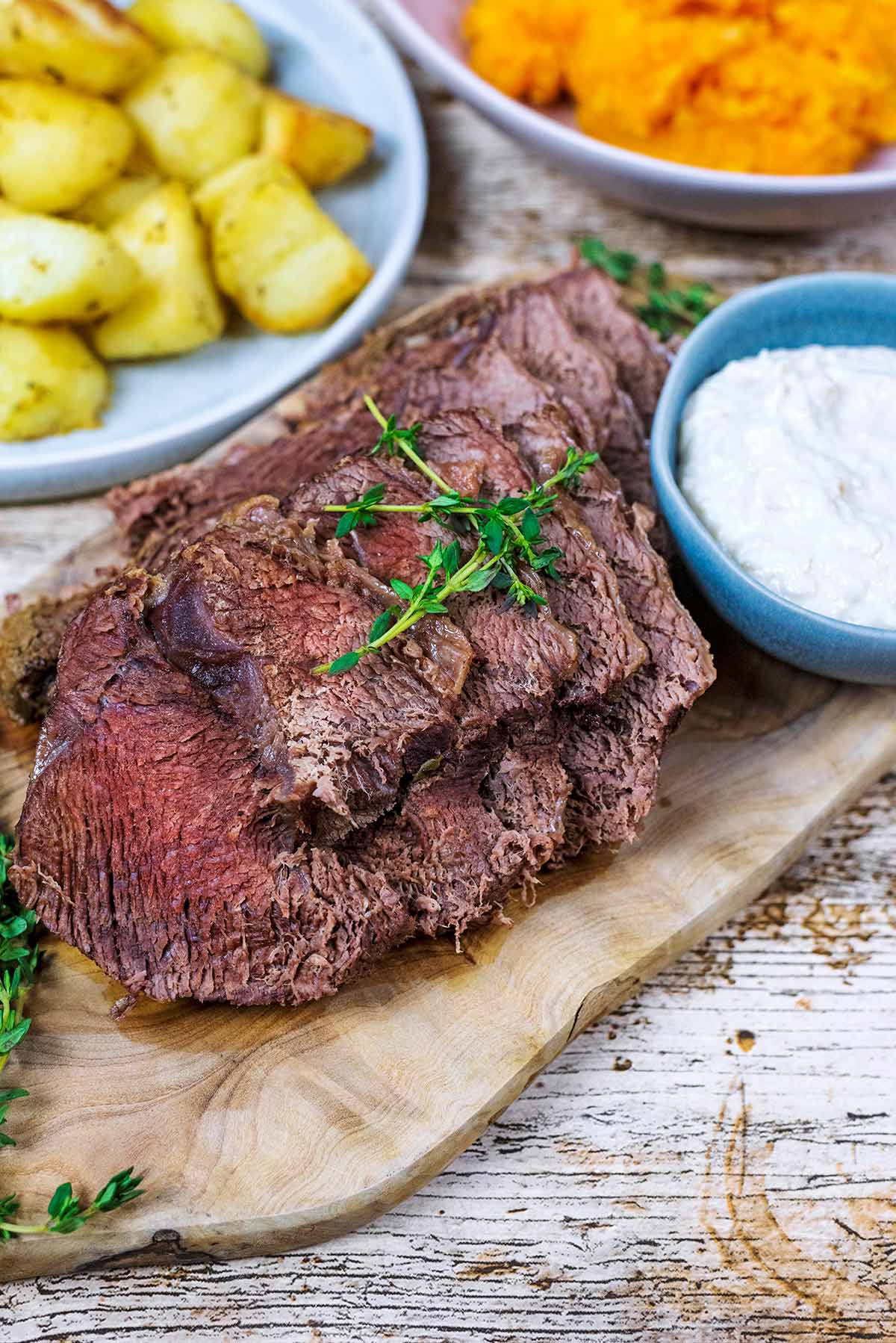
This slow cooker roast beef is melt-in-the-mouth tender, but still firm enough to slice, and it comes with the bonus of a rich homemade gravy made from all those delicious cooking juices.
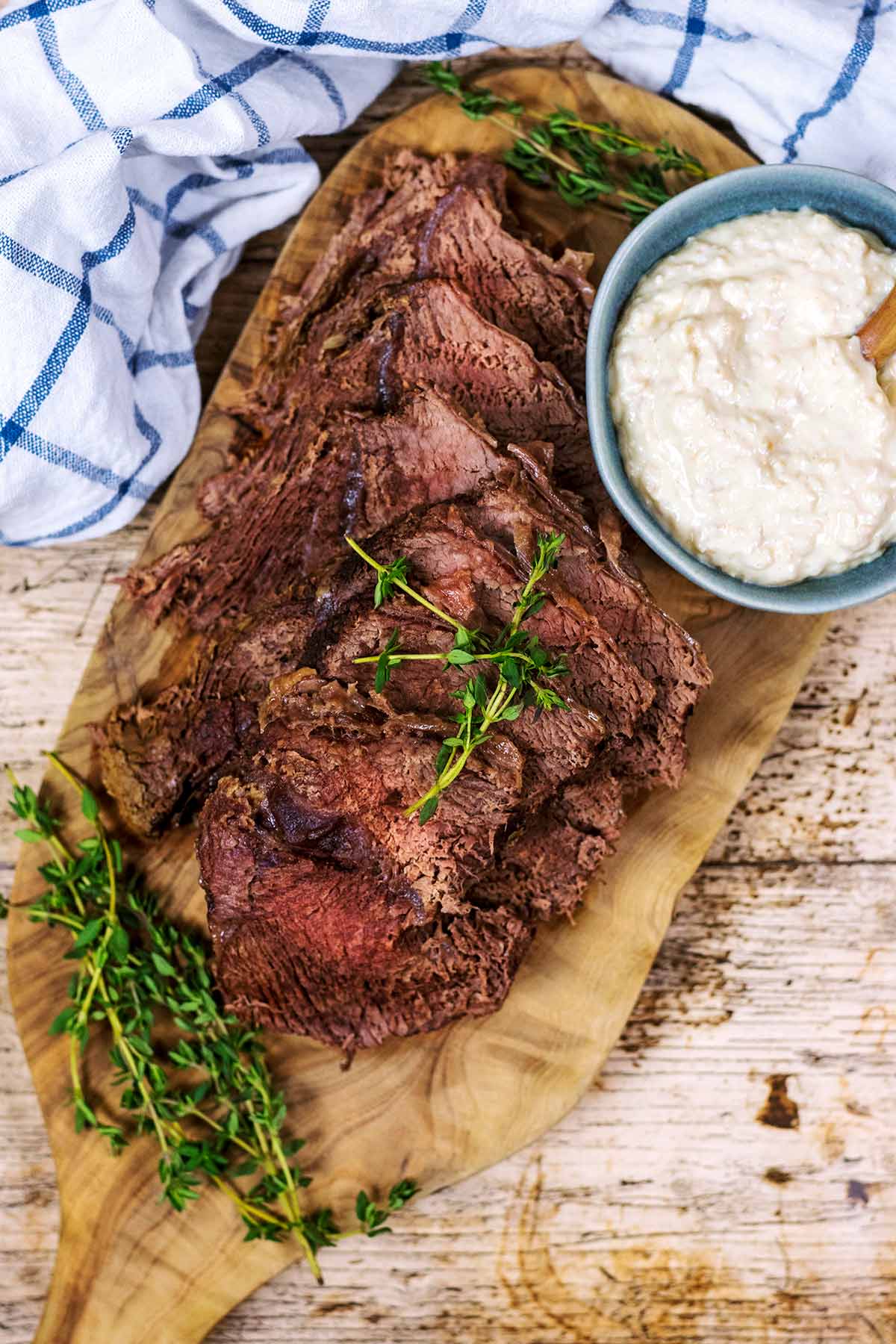
A roast dinner is one of my favourite family meals, but I don't love trying to fit everything into the oven at the same time.
Cooking the beef joint in the slow cooker means I can get it started earlier in the day and then forget about it while I get on with everything else. It also leaves the oven completely free for the really important things - crispy roast potatoes, cauliflower cheese and all the trimmings.
This is one of my favourite recipes to use at Christmas when oven space is at a premium. Put the beef on earlier in the day and you have one less thing competing for space when everything else needs cooking.
We use topside beef for a tender, sliceable roast rather than a shredded pot-roast texture. There's no red wine needed and no need to surround the beef with potatoes and carrots either. Just beautifully tender beef and proper, spoon-coating beef gravy.
Recipe update: This recipe was originally published on 2 December 2020 and was fully retested in October 2026 to check the cooking time and ingredient quantities. The original recipe still worked well, but I've expanded the instructions, tips and FAQs.
Would you like to save this post?
Jump to:
- Why You'll Love It
- Recipe Overview
- Slow Cooker Roast Beef vs Beef Brisket
- Ingredients and Substitutions
- What is the Best Beef Joint for Slow Cooker Roast Beef?
- How to Cook Melt-in-the-Mouth Roast Beef in the Slow Cooker
- Slow Cooker Roast Beef Cooking Times
- How to Make Slow Cooker Roast Beef Gravy
- Serving Suggestions
- Slow Cooker Roast Beef for Christmas Dinner
- Storage and Leftovers
- How To Use Leftovers
- Troubleshooting Guide
- Dannii's Top Tips
- Frequently Asked Questions
- More Slow Cooker Beef Recipes
- Recipe
- Feedback
Why You'll Love It
- Melt-in-the-mouth beef - Slow cooking gently tenderises the beef while keeping a topside joint sliceable.
- Proper homemade gravy - The cooking juices make an intensely beefy gravy rather than a thin au jus.
- Perfect for Sunday dinner - Get the main part of your roast cooking early and leave the oven free for the sides.
- Ideal for Christmas - A great option when oven space is limited and you want something you can largely leave to cook itself.
- No wine needed - Beef stock, garlic, shallots and thyme give the cooking liquid plenty of flavour.
- Great for feeding a crowd - A 1.5kg joint gives around 8-10 servings depending on appetites and how many sides you are serving.
Recipe Overview
- Prep time: About 15 minutes
- Cook time: 7 hours on low or around 4 hours on high
- Resting time: 20-30 minutes
- Serves: 8-10
- Best cut: Topside beef joint / top round
- Best for: Sunday dinner, Christmas dinner and feeding a crowd
- Difficulty: Easy
Slow Cooker Roast Beef vs Beef Brisket
Although both work brilliantly for an easy Sunday lunch, a traditional roasting joint and beef brisket give quite different results in the slow cooker.
For this slow cooker roast beef, I use a roasting joint such as topside. It gives you the more traditional roast beef texture, with tender meat that can be carved into neat slices and served with roast potatoes, Yorkshire puddings, vegetables and gravy.
Brisket, on the other hand, contains more connective tissue and benefits from a longer, slower cook. The result is softer, richer beef that can still be sliced when cooked to the right point, or cooked a little longer until it is easy to shred.
If that is the kind of beef you are looking for, try my slow cooker beef brisket instead. It includes timings for a brisket joint, how to tell when it is properly tender and how to turn the cooking juices into gravy.
Both are great Sunday-roast options, but I choose this recipe when I want classic sliced roast beef, and brisket when I want something especially tender and slow-cooked.
Ingredients and Substitutions
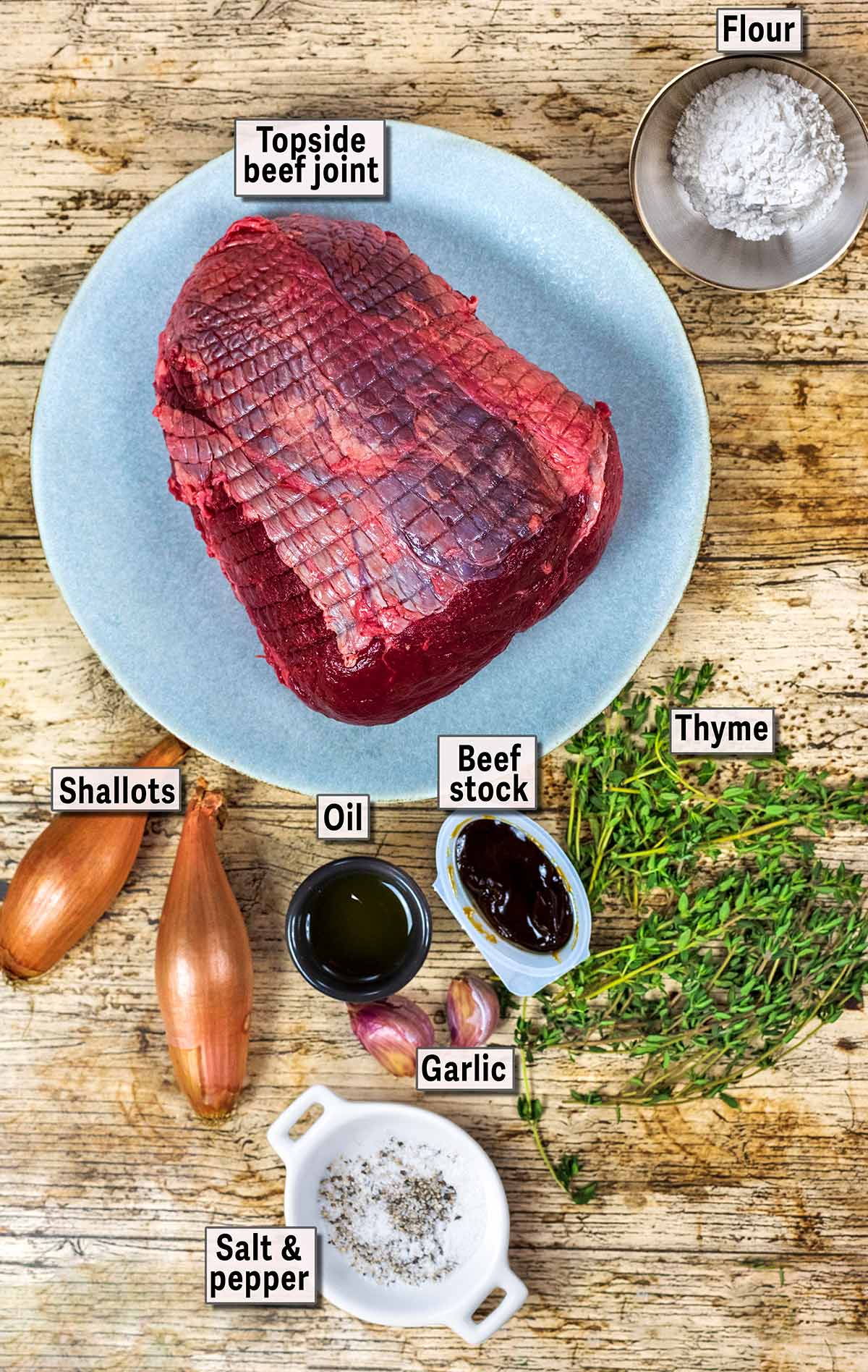
A full ingredients list, along with US Customary and Metric measurements, can be found in the recipe card at the end of this post.
- Beef joint - We use a 1.5kg topside beef joint. In the US, this is usually called top round. It is lean enough to give you neat slices but becomes really tender when cooked slowly.
- Plain flour - A light coating helps the outside of the beef brown when it is seared. Shake off any excess before putting the joint into the pan.
- Olive oil - You only need a little for searing the beef. Another neutral cooking oil will work too.
- Shallots - These add a slightly sweeter, milder flavour to the gravy. You can use a small brown onion instead.
- Garlic - Fresh garlic adds plenty of flavour to the cooking liquid.
- Beef stock - This becomes the base of the gravy. Use a good-quality beef stock, preferably a lower-salt one so you can adjust the seasoning after it has reduced.
- Fresh thyme - Thyme and beef are such a good combination. Fresh rosemary can be used instead if that is what you have.
- Cornflour (not pictured) - Also known as cornstarch in the US. This is mixed with a little cold water and added to the cooking juices to turn them into a smooth, thick gravy.
- Salt and pepper - Season the beef generously before searing it.
You don't need red wine for this slow cooker roast beef. If you do want to use some, a small splash can be added to the hot frying pan after searing the beef to lift all the browned bits before pouring everything into the slow cooker.
What is the Best Beef Joint for Slow Cooker Roast Beef?
If you want slow cooker roast beef that can still be sliced, we recommend topside.
Topside, called top round in the US, is a fairly lean roasting joint. Cooking it gently in stock keeps it moist and tender, while its structure means you can still carve it into proper slices for a roast dinner.
Silverside can also be cooked in the slow cooker. It is another lean cut and can work well, although the finished texture may be slightly firmer.
Brisket or chuck are excellent slow-cooking cuts too, but they give a different result. They contain more connective tissue and are better when you want very soft, falling-apart or shredded beef rather than neat slices of roast beef.
So, for the classic Sunday-roast result you see here, topside is our first choice.
How to Cook Melt-in-the-Mouth Roast Beef in the Slow Cooker
- Prepare the beef. Take the beef out of its packaging and pat it thoroughly dry with kitchen paper.
Drying the beef is important. A wet joint will steam in the pan rather than developing that deep brown colour that gives the finished dish so much flavour.
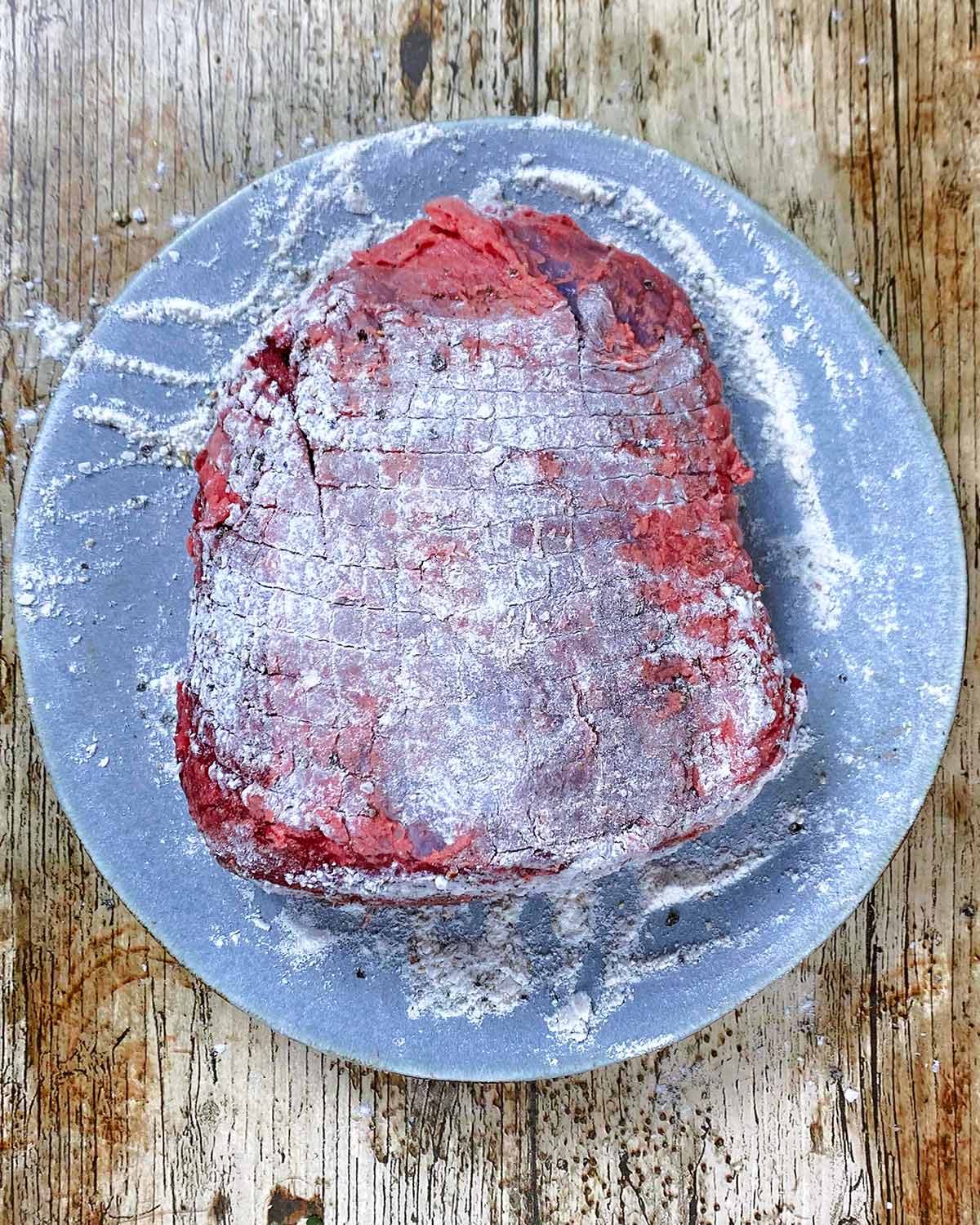
- Coat the beef: Season all over with salt and pepper, then coat it lightly in the plain flour, shaking off any excess.
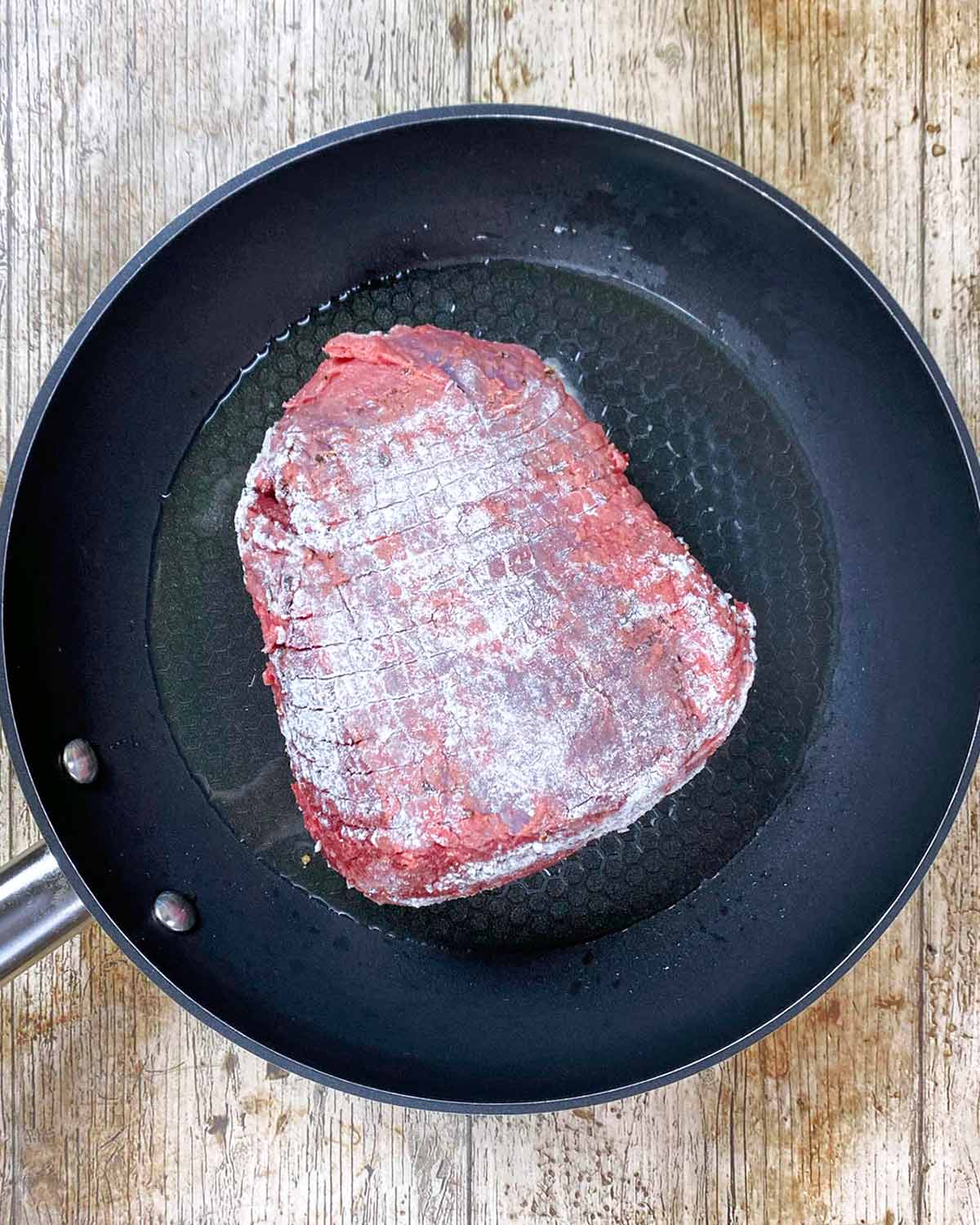
- Brown the beef. Heat the oil in a large frying pan over a medium-high heat.
- Add the beef and sear it on all sides until deeply browned. Take your time with this - it takes around 8-10 minutes to get plenty of colour all over a large joint.
You aren't trying to cook the beef at this stage. The browning is simply adding another layer of flavour.
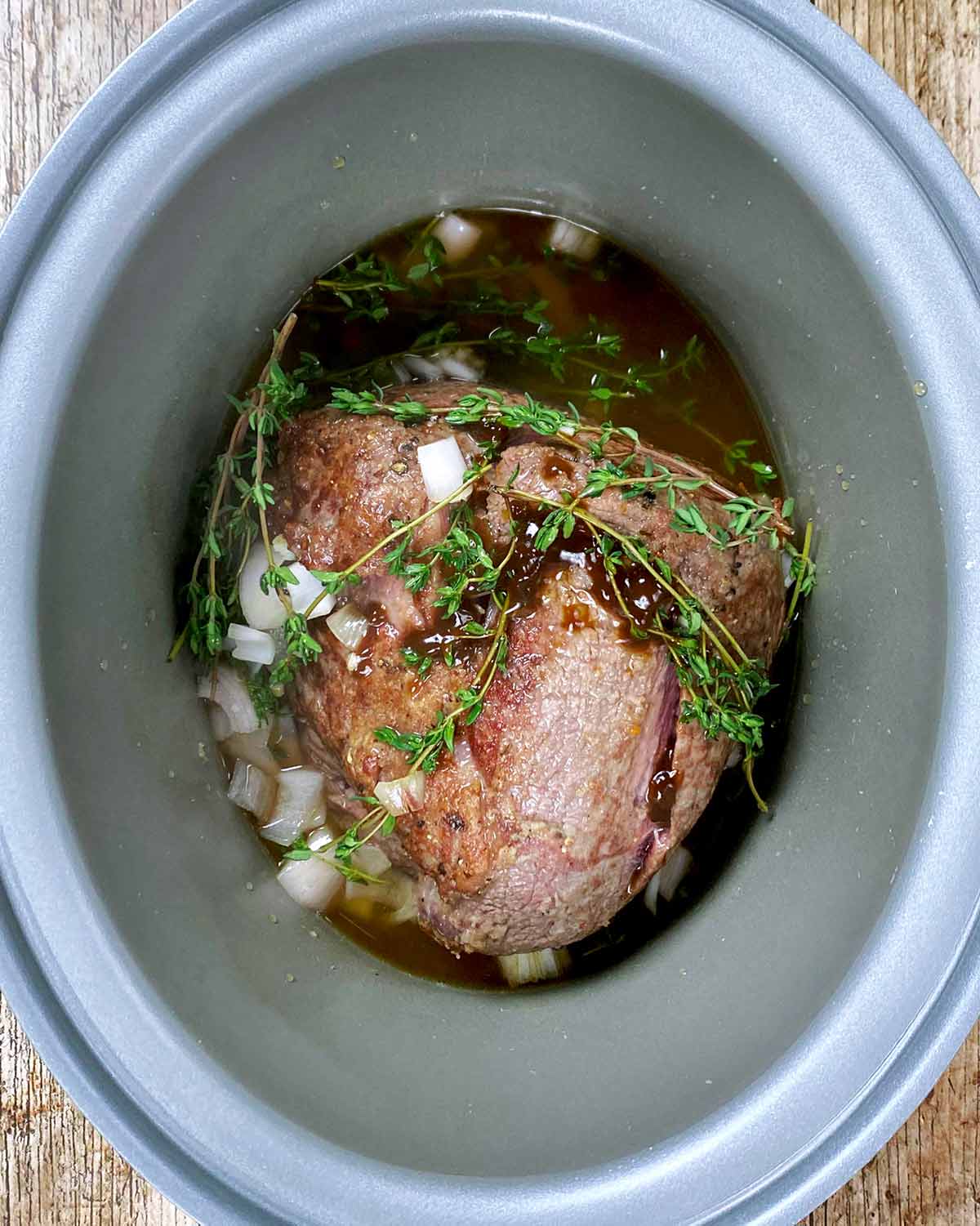
- Prepare the slow cooker. Put the diced shallots, garlic and thyme into the slow cooker and pour in the beef stock.
💡 If there are lots of browned bits left in your frying pan, pour in a small splash of stock and scrape them from the bottom of the pan, then add that liquid to the slow cooker too. There is so much flavour there that you don't want to waste it.
- Add the beef. Sit the browned beef joint in the slow cooker.
The stock does not need to cover the beef. The joint will release more liquid as it cooks and the closed slow cooker prevents much moisture from escaping.
💡 If your beef is tied with butcher's string to hold its shape, leave the string in place while it cooks.
- Put the lid on the slow cooker.
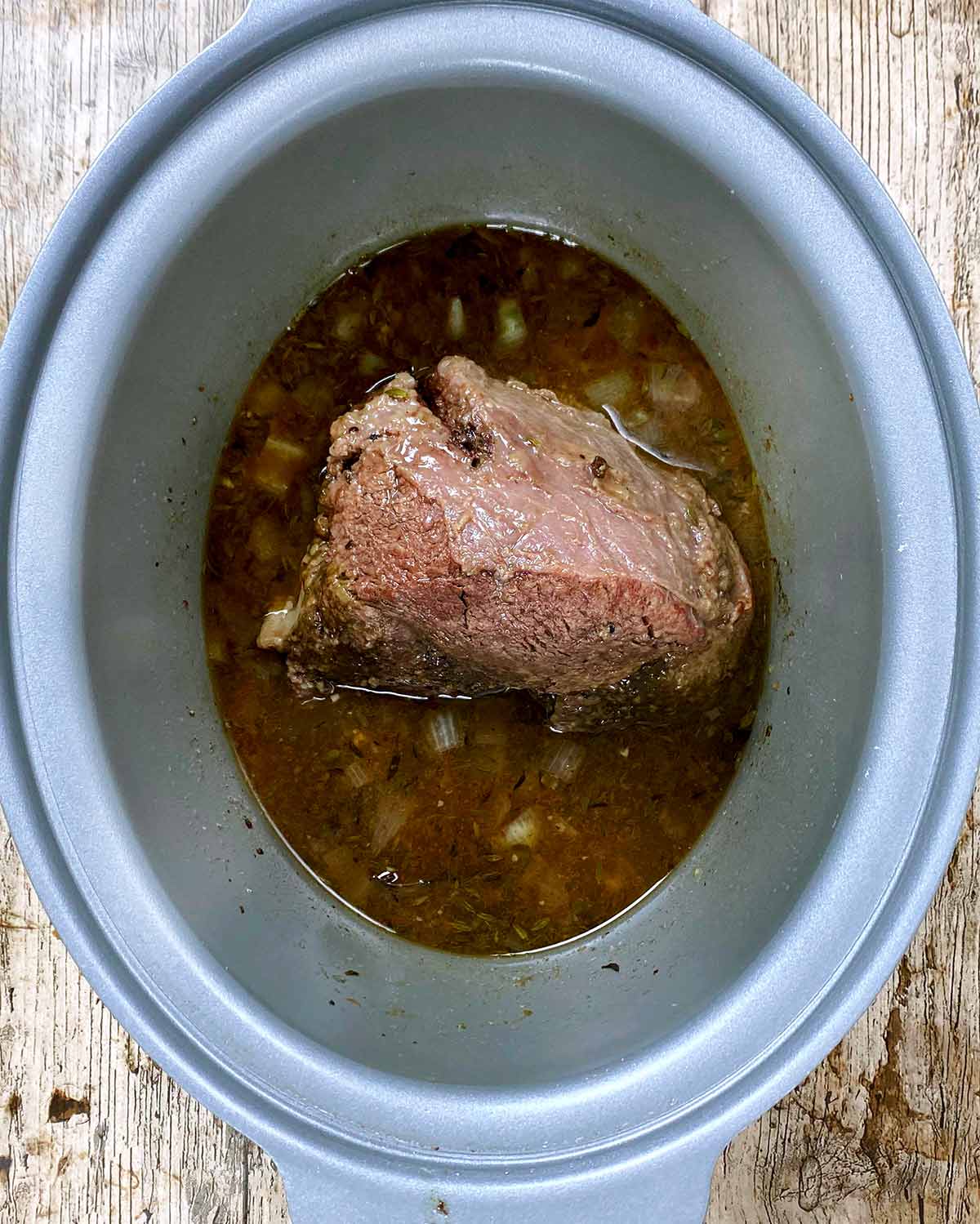
- Slow cook. Cook for approximately:
7 hours on LOW, or
4 hours on HIGH.
We prefer the low setting when we have time, as the longer, gentler cook gives beautifully tender beef.
Slow cookers vary, as do the thickness and shape of beef joints, so use these timings as a guide rather than treating them as an exact per-kilogram formula.
⚠️ Try not to keep removing the lid to check the beef, as every time you open the slow cooker you release heat.
- Rest the beef. Carefully lift the beef onto a board or warm plate and cover it loosely with foil.
Leave it to rest for 20-30 minutes while you make the gravy (see below).
This is worth waiting for. Resting makes the beef easier to carve and helps keep the slices juicy.
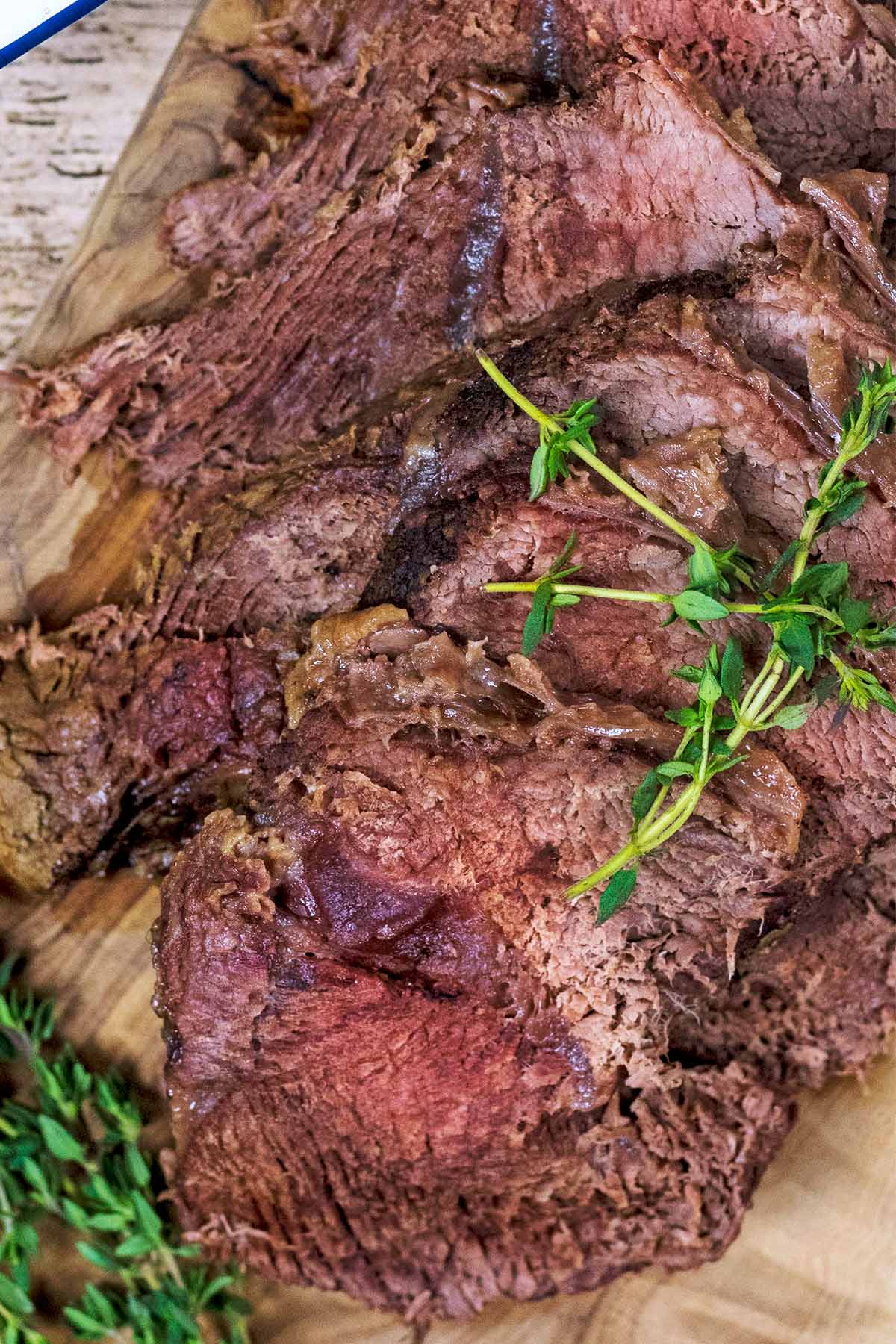
- Carve the beef: Remove any butcher's string just before carving and slice the beef across the grain.
Slow Cooker Roast Beef Cooking Times
For the 1.5kg topside beef joint used in this recipe, these are the timings we use:
| Setting | Cooking time | Resting time |
|---|---|---|
| Low | Approx. 7 hours | 20-30 minutes |
| High | Approx. 4 hours | 20-30 minutes |
LOW is our preferred method if time allows.
There isn't a completely reliable "minutes per kilogram" calculation for a slow cooker. Two joints of the same weight can be different shapes and thicknesses, and slow cookers themselves can run at different temperatures.
For this recipe, we used a 6.5L slow cooker.
If you are using a significantly smaller or larger joint, you may therefore need to adjust the cooking time. Make sure the joint fits comfortably in your slow cooker rather than being tightly wedged against the sides.
This recipe is designed to produce tender, fully slow-cooked beef that can still be sliced. If what you want is very pink rare or medium-rare roast beef, traditional oven roasting gives you much greater control over that style of doneness.
How to Make Slow Cooker Roast Beef Gravy
One of the best things about cooking a beef joint this way is that nothing goes to waste. The beef stock, shallots, garlic, herbs and juices from the meat become an incredibly flavourful gravy.
Once the beef has been removed to rest, strain the cooking liquid into a saucepan. You can press some of the softened shallot through the sieve if you want even more flavour and body.
If there is a lot of fat sitting on the surface, skim a little off.
Bring the liquid to a gentle simmer.
Mix 1 tablespoon of cornflour with a little cold water until completely smooth. Slowly pour it into the simmering cooking liquid while whisking.
Cook for around 5-10 minutes, or until the gravy has thickened to your preferred consistency.
Remember that the gravy will thicken slightly more as it cools. If it becomes too thick, simply whisk in a splash of water or beef stock.
Taste it before adding any extra salt because the stock and reduced cooking juices may already contain plenty.
The result should be proper, rich roast-beef gravy, rather than a thin cooking broth.
Serving Suggestions
One of the main reasons I love making roast beef in the slow cooker is that the oven is left free for all the sides.
For a classic Sunday dinner, serve it with easy roast potatoes, creamy mashed potatoes or air fryer roast potatoes. Then add our easy cauliflower cheese, honey roasted parsnips, garlic and parsley roasted carrots and some green vegetables.
A little sage and onion stuffing or air fryer stuffing balls works really well alongside it too.
You already have a rich gravy from the slow cooker, but our easy onion gravy is another option if you are feeding a large crowd and want plenty of extra gravy on the table.
Slow Cooker Roast Beef for Christmas Dinner
Slow cooker roast beef is a great option for Christmas dinner because it keeps the oven free for roast potatoes, stuffing and all the other sides.
I get the beef cooking earlier in the day, then once it is ready it can rest for 20-30 minutes while the gravy is made and everything else is finished. When you're juggling several dishes at once, having the main part of dinner taking care of itself makes Christmas dinner much easier.
For Christmas dinner, we go all out with the extras. Add air fryer pigs in blankets, slow cooker red cabbage, roast parsnips, carrots, Brussels sprouts and stuffing.
Storage and Leftovers
In the fridge: Allow leftover beef to cool and store it in an airtight container in the fridge for up to 3 days. If possible, keep some of the gravy with it as this helps the beef stay moist.
In the freezer: Sliced roast beef can be frozen for up to 3 months. We recommend freezing it with some gravy. Defrost thoroughly in the fridge overnight before reheating.
To reheat: Put the sliced beef into an ovenproof dish with some gravy, cover and reheat at 170°C/150°C fan/340°F/Gas 3 until piping hot throughout. You can also gently reheat individual portions in a saucepan with gravy.
How To Use Leftovers
You are going to want to make more than you think you need, as the leftovers are amazing in a sandwich. We like the beef, with a little of the gravy, in between 2 slices of sourdough, with some horseradish, rocket lettuce and sun-dried tomatoes. Try our leftover roast beef sandwich recipe.
It also goes well shredded in a pasta bake. You could also use leftovers to make our shredded beef tacos or beef burrito bowl.
If you have any gravy leftover, you can wait for it to cool and then pour it into freezer bags and freeze flat.
Troubleshooting Guide
| Problem | Likely cause | Fix |
|---|---|---|
| The beef is still tough | It may simply need longer for the fibres to soften. | Return it to the slow cooker with the gravy and cook a little longer. If it has already been sliced, 30-60 minutes in the gravy can help. |
| The beef is dry | A lean joint may have cooked for too long. | Serve it generously with gravy and reheat leftovers in gravy. Reduce the cooking time slightly next time. |
| The gravy is too thin | There is too much liquid for the amount of thickener. | Simmer it uncovered to reduce first, then add a little more cornflour slurry if necessary. |
| The gravy is lumpy | Cornflour was added directly to hot liquid. | Always mix the cornflour with cold water until smooth before whisking it into the hot gravy. |
| The beef falls apart when I carve it | It may have cooked for too long, or you may be using a cut such as brisket or chuck. | Use topside for neater slices and make sure the beef rests before carving. |
| The beef didn't brown properly | The surface was wet or the frying pan wasn't hot enough. | Pat the joint thoroughly dry and sear it in a properly heated pan. |
| There is too much liquid in the slow cooker | Beef releases its own juices as it cooks. | This is normal. Remove the beef, then simmer the liquid uncovered before thickening it into gravy. |
Dannii's Top Tips
- Pat the beef completely dry before flouring and searing it - this is the key to getting plenty of colour.
- Don't rush the searing stage. Those dark browned bits add a huge amount of flavour to the finished gravy.
- Leave butcher's string around the joint while it cooks so it holds its shape, then remove it before carving.
- Try not to lift the slow-cooker lid during cooking, as this lets heat escape.
- The LOW setting is our preferred option when time allows.
- Let the beef rest before slicing. It makes a noticeable difference to both texture and juiciness.
- Always carve across the grain for the most tender slices.
- Taste the gravy after it has reduced before adding more seasoning, particularly if your beef stock is already salty.
- If you want to add extra flavour to the cooking liquid, a carrot or stick of celery can be added, but we prefer cooking the roast-dinner vegetables separately so they keep their own texture.
- Fresh rosemary can be used instead of thyme if you prefer it with beef.
Frequently Asked Questions
No. The beef will cook safely without being seared first, so you can skip this step if you are really short on time.
However, we strongly recommend searing it if you can. Browning creates a much deeper savoury flavour and also improves the colour and flavour of the gravy.
Yes. You don't need to cook potatoes or carrots around the beef to keep it moist. The beef cooks in stock with shallots, garlic and herbs, and it releases more liquid as it cooks. We actually prefer to cook our roast potatoes and vegetables separately so they stay crisp rather than becoming soft in the slow cooker.
Yes. You can add chunky carrots or small potatoes if you want an all-in-one meal.
For a traditional Sunday roast, though, we prefer to cook them separately. Roast potatoes are much better when they are properly crisp from the oven or air fryer.
For our 1.5kg beef joint we use 500ml of beef stock.
The liquid doesn't need to cover the beef. Slow cookers lose very little moisture and the joint itself will release more juices as it cooks.
Adding enough liquid to completely submerge it would dilute all that lovely beef flavour and leave you with far more cooking liquid than you need.
No. This recipe is deliberately made without wine and has plenty of flavour from the beef stock, shallots, garlic, herbs and browned beef.
If you enjoy red wine with beef, you can use a small splash to deglaze the frying pan after searing, but it is entirely optional.
Remove all normal packaging first.
If your beef joint has butcher's string tied around it to hold its shape, leave that in place while it cooks and rests. Remove the string immediately before carving.
You can do much of the prep ahead. Chop the shallots and garlic and measure the other ingredients so everything is ready to go in the morning.
Yes, but slow-cooker timing doesn't scale perfectly according to weight.
The shape and thickness of the joint matter, as does the size and temperature of your slow cooker. A very large joint that is wedged tightly into the pot will behave differently from a smaller one with space around it.
If you are cooking for a particularly large group, two manageable joints can sometimes be more practical than trying to squeeze one enormous joint into the slow cooker.
Yes. Silverside can be slow cooked and makes a good alternative, although it is quite lean and the finished texture may be a little firmer.
For this particular recipe, topside remains our first choice when we want tender beef that still carves into attractive slices.
No. Defrost the beef completely in the fridge before putting it in the slow cooker. Starting with frozen meat means it can take too long to reach a safe cooking temperature and it will also make the cooking time much harder to predict.
More Slow Cooker Beef Recipes
If you've tried this slow cooker roast beef, let us know how you got on in the comments.
It's especially helpful to hear what size beef joint you used and whether you cooked it on LOW or HIGH.
Tag us in your creations on Instagram @hungryhealthyhappy and use the hashtag #hungryhealthyhappy too.
Recipe
Slow Cooker Roast Beef with Gravy



Recipe Video
Ingredients
- 1.5 kg (3 ⅓ lb) of Beef joint
- ½ teaspoon of Fine sea salt
- 1 teaspoon of Ground black pepper
- 4 tablespoons of Plain flour
- 1 teaspoon of Olive oil
- 2 Shallots - diced
- 2 Garlic cloves - crushed
- 10 g (¼ cup) of Fresh thyme
- 500 ml (2 cups) of Beef stock
- 1 tablespoon of Cornflour (corn starch)
- 2 tablespoons of Cold water
Instructions
- Prepare the beef. Take 1.5 kg of Beef joint out of its packaging and pat it thoroughly dry with kitchen paper.
- Coat the beef: Season all over with ½ teaspoon of Fine sea salt and 1 teaspoon of Ground black pepper, then coat it lightly in 4 tablespoons of Plain flour, shaking off any excess.
- Brown the beef. Heat 1 teaspoon of Olive oil in a large frying pan over a medium-high heat.Add the beef and sear it on all sides until deeply browned. Take your time with this - it takes around 8-10 minutes to get plenty of colour all over a large joint.
- Prepare the slow cooker. Put 2 Shallots (diced), 2 Garlic cloves (crushed) and 10 g of Fresh thyme into the slow cooker and pour in 500 ml of Beef stock.
- Add the beef. Sit the browned beef joint in the slow cooker.The stock does not need to cover the beef. The joint will release more liquid as it cooks and the closed slow cooker prevents much moisture from escaping.
- Put the lid on the slow cooker.
- Slow cook. Cook for approximately:7 hours on LOW, or 4 hours on HIGH.
- Rest the beef. Carefully lift the beef onto a board or warm plate and cover it loosely with foil.Leave it to rest for 20-30 minutes while you make the gravy.
- Make the gravy: Strain the cooking liquid from the slow cooker into a saucepan. Bring to a gentle simmer. Mix 1 tablespoon of Cornflour (corn starch) with up to 2 tablespoons of Cold water until smooth, then gradually whisk it into the cooking liquid. Simmer for 5-10 minutes, until thickened to your liking.Taste and season if needed.
- Carve the beef: Remove any butcher's string just before carving and slice the beef across the grain.
Recipe Notes
- Pat the beef completely dry before flouring and searing it - this is the key to getting plenty of colour.
- Don't rush the searing stage. Those dark browned bits add a huge amount of flavour to the finished gravy.
- Leave butcher's string around the joint while it cooks so it holds its shape, then remove it before carving.
- Try not to lift the slow-cooker lid during cooking, as this lets heat escape.
- The LOW setting is our preferred option when time allows.
- Let the beef rest before slicing. It makes a noticeable difference to both texture and juiciness.
- Always carve across the grain for the most tender slices.
- Taste the gravy after it has reduced before adding more seasoning, particularly if your beef stock is already salty.
- If you want to add extra flavour to the cooking liquid, a carrot or stick of celery can be added, but we prefer cooking the roast-dinner vegetables separately so they keep their own texture.
- Fresh rosemary can be used instead of thyme if you prefer it with beef.
Nutritional Information
Where nutritional information is provided, it is approximate and calculated using online tools. Values can vary depending on the ingredients and brands used, but we endeavour to be as accurate as possible.
All timings are a guide and may vary depending on the ingredients, equipment and, where relevant, the appliance used. Changing the serving size may also affect the time needed.

P Waldo says
I have not tried the recipe, but I have a question. Does this recipe with the beef stock provide real gravy? The other recipes I have seen are for roast beef served au jus. To me, au jus tasting like a tin of cheap consomme has been poured over top of the meat,is a waste of a good cut. If this recipe provides real gravv without making the roast taste as if it's been boiled in the stock, I'm eager to try it.
Dannii Martin says
If you follow the step to use the juices to make the gravy with cornflour (and red wine), then it does make gravy, yes.
Sara Welch says
Enjoyed this for dinner last night and it did not disappoint! Was the perfect dinner for a busy weeknight; my whole family loved it!
Aimee Mars says
I've done many roast beef recipes before but I've never used beef joint. This looks like a great weeknight option, especially since I can make it in the slow cooker.
Sharon Chen says
Yummy recipe! Slow Cookers are really the best!
Jessica Stroup says
We had this last night and my family of 5 loved it! No complaints at the dinner table and plenty of clean plates!
Jess says
This is the BEST way to cook roast beef. Yum!
Angela K says
I have made this so many times; that I thought it was about time I left a review. This is the best roast beef I have ever made. I am not the best cook, but I have never messed this up. The beef really does just melt in your mouth and it’s so easy too. I have made it with and without browning the beef and it’s definitely worth the extra time to brown to. I will be trying some of your other roast meat recipes soon.
Tom says
I made this for Christmas Day and it was incredible. Perfectly cooked and it made the beef gravy too. Everyone was very happy and it made a nice change from dry turkey.
stan dupp says
made me really squeek!
Dannii says
Squeek?
Natalie says
I never made roast beef in the slow cooker. Looks easy and the meat is delicious, tender, and perfect. I will give it a try. Thanks!
veenaazmanov says
Thanks for such a delicious recipe and best for my weekend planning. Looks Soft, juicy , flavorful and mouth melting .....Yum