


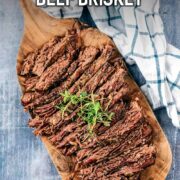

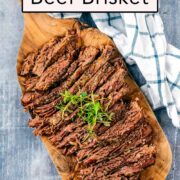
This Slow Cooker Beef Brisket is one of my favourite ways to turn an inexpensive joint of beef into something that feels like a proper Sunday lunch. The brisket cooks low and slow until it is incredibly tender, but you can still slice it neatly for a roast dinner rather than it immediately falling to pieces.

This is the sort of Sunday roast I love when I don't want to spend the whole morning keeping an eye on the oven. I get the brisket started early, then the slow cooker does most of the work while I get on with the rest of the day. By the time I need to think about roast potatoes and vegetables, the main part of dinner is already under control.
The cooking juices are full of flavour too, so don't throw them away - they make an amazing gravy. And I nearly always cook more brisket than we need because the leftovers make ridiculously easy dinners for the next day or so.
For the 2kg beef brisket joint used in this recipe, cook it for around 8 hours on LOW or 6 hours on HIGH, but treat cooking time as a guide rather than the only test. Brisket is ready when a fork or temperature probe slides into the thickest part with very little resistance.
Recipe update: This recipe was originally published on 25 November 2021 and was fully retested in October 2026 to check the cooking time and ingredient quantities. The original recipe still worked well, but I've expanded the instructions, tips and FAQs.
Would you like to save this post?
Jump to:
- Why You'll Love This Slow Cooker Beef Brisket
- Recipe Overview
- What Beef Brisket Should I Buy?
- Beef Brisket vs Slow Cooker Roast Beef
- Ingredients and Substitutions
- How To Make Slow Cooker Beef Brisket
- How Long to Cook Beef Brisket in the Slow Cooker?
- How do I Know When Slow Cooker Beef Brisket is Done?
- How to Make Gravy From the Slow Cooker Juices
- Slow Cooker Brisket for a Sunday Roast
- What To Do With Leftover Beef Brisket
- Storage
- Dannii's Top Tips
- Troubleshooting Guide
- Frequently Asked Questions
- More Slow Cooker Beef Recipes
- Recipe
- Feedback
Why You'll Love This Slow Cooker Beef Brisket
- Easy - It's mostly hands-off, which makes it ideal for a Sunday roast when you have enough other things to juggle.
- Budget friendly - Brisket is also a fantastic cut for slow cooking. It starts off relatively tough because it contains a lot of connective tissue, but a long gentle cook turns it tender and full of flavour.
- Versatile - It works for much more than one meal too. Serve it sliced with roast potatoes and gravy the first day, then shred the leftovers for sandwiches, baked potatoes, wraps, tacos or a quick pie filling.
Recipe Overview
- Prep time: 10 minutes
- Cook time: 8 hours on LOW or 6 hours on HIGH
- Resting time: 10-15 minutes
- Serves: 10
- Brisket: 2kg/4½lb rolled beef brisket joint
- Slow cooker: 6.5 litre capacity
- Difficulty: Easy
- Best for: Sunday roast, family dinners and leftovers
- Texture: Tender and sliceable, or cook a little longer if you want shredded brisket
What Beef Brisket Should I Buy?
For this recipe you need fresh beef brisket, rather than corned beef brisket.
In UK supermarkets and butchers you will often see brisket sold as a rolled beef brisket joint, which is ideal for this recipe. If it is tied with butcher's string, leave the string on while it cooks because it helps the joint hold its shape. Remove it after resting and before slicing.
I prefer a joint with a little visible fat rather than one that has been trimmed completely lean. That fat adds flavour and helps protect the meat during the long cooking time. If there is an exceptionally thick layer you can trim some away, but there is no need to remove every bit.
If your brisket has a clear fat cap, put that side uppermost in the slow cooker.
A 2kg/4½lb joint needs a reasonably large slow cooker (we used a 6.5L slow cooker). The important thing is that the brisket fits without preventing the lid from closing properly. If your joint is too long, you can cut it into two large pieces rather than forcing it into the bowl.
US readers: a Crock-Pot is simply a brand of slow cooker, so the same method applies. Make sure you buy fresh brisket rather than corned beef brisket for this particular recipe.
Beef Brisket vs Slow Cooker Roast Beef
Although both are great options for an easy Sunday lunch, beef brisket and a traditional roasting joint behave quite differently in the slow cooker.
Brisket is a tougher cut with more connective tissue, so it really benefits from a long, slow cook. Given enough time, it becomes incredibly tender and full of flavour, while still being sliceable if you take it out at the right point. It is a great choice if you want a rich, comforting roast with plenty of cooking juices for gravy.
If you are looking for a more traditional roast beef texture, with neat slices and a slightly firmer finish, try my slow cooker roast beef instead. That recipe uses a roasting joint such as topside and is better suited to anyone wanting classic roast beef rather than the softer, slow-cooked texture you get from brisket.
Both work brilliantly with roast potatoes, vegetables, Yorkshire puddings and gravy, but brisket is the one I tend to choose when I want something especially low-effort and forgiving for Sunday dinner.
Ingredients and Substitutions

A full ingredients list, along with US Customary and Metric measurements, can be found in the recipe card at the end of this post.
- Olive oil - Just enough to sear the outside of the brisket. A neutral cooking oil is fine too.
- Beef brisket - I use a 2kg/4.5lb rolled brisket joint. Buying from a butcher is ideal because you can ask for a joint of the right size and thickness for your slow cooker.
- Beef stock - You only need a relatively small amount to get the cooking started. The brisket and onion will release more liquid as they cook.
- Worcestershire sauce - This brings plenty of savoury depth to the cooking juices. If you can't use Worcestershire sauce, it can simply be omitted and the seasoning adjusted at the end. Henderson's Relish can be used as an alternative to Worcestershire sauce. If you are cooking for allergies or intolerances, always check the label to make sure it is suitable for your individual requirements.
- Onion - As well as flavouring the meat, the softened onion makes the cooking liquid even better for gravy.
- Garlic - Fresh garlic gives the best flavour, although ready-prepared garlic is useful when you're short on time.
- Thyme - Thyme and beef are a classic combination. Rosemary is a good substitute.
- Salt and pepper - Season the brisket generously before browning.
- Optional red wine variation - For a richer Sunday-roast flavour, replace a small amount of the beef stock with red wine. You don't need much - this recipe should still taste predominantly of beef rather than wine.
How To Make Slow Cooker Beef Brisket

- Season the brisket: Pat the brisket dry, then season it well all over with salt and freshly ground black pepper. A dry surface browns much more effectively than a wet one.
- Brown it: Heat the olive oil in a large frying pan and sear the brisket on every side until it has a good brown crust. This only takes a few extra minutes but adds a lot of flavour.
If you're having one of those mornings where even an extra frying pan feels like too much, you can skip the browning. It will still work. I prefer it browned when we're having it as a Sunday roast because both the beef and the gravy taste richer.

- Add everything to the slow cooker: Put the sliced onion, garlic, beef stock, Worcestershire sauce and thyme into the slow-cooker bowl. Sit the browned brisket on top, with the fat side facing upwards if it has an obvious fat cap.

- Slow cook: Cover and cook for approximately 8 hours on LOW or 6 hours on HIGH for the 2kg joint used here.
LOW is my preference when there is time. Brisket benefits from the gentler, longer cooking, and it makes the timing of a Sunday lunch wonderfully relaxed. - Check for tenderness: Don't rely on the clock alone. Push a fork or temperature probe into the thickest part of the meat. When the brisket is properly tender, it should slide in with very little resistance. If it is still firm or chewy, it usually needs more time, not less.
- Rest before slicing: Lift the brisket onto a board and loosely cover it. Rest for around 10-15 minutes while you finish the gravy. Remove the string, then slice the brisket against the grain for the most tender slices.
How Long to Cook Beef Brisket in the Slow Cooker?
This is one of the questions I get asked most, and the important thing to know is that brisket cooking time does not scale perfectly according to weight.
The thickness and shape of the joint matter, as does the size and temperature of your slow cooker. Two 1kg briskets can therefore take different amounts of time if one is short and thick and the other is long and thin.
For my 2kg brisket, around 8 hours on LOW or 6 hours on HIGH is the starting point.
1kg beef brisket slow cooker time
A 1kg brisket can finish significantly earlier than a 2kg joint, so don't simply leave it for the full cooking time.
I would start checking a 1kg joint well before the eight-hour mark on LOW, and remove it as soon as it is properly tender. This is one of those recipes where checking the meat is far more reliable than blindly following a timer.
As a guide, it would be on LOW for 6-7 hours and HIGH for 4-5 hours.
How do I Know When Slow Cooker Beef Brisket is Done?
Brisket needs to cook beyond the point where beef is merely "cooked" because the goal is to soften the collagen and connective tissue.
The best test is tenderness. A fork or probe should go into the thickest part easily.
For tender brisket, the internal temperature is commonly somewhere around 88-96°C / 190-205°F, but use this alongside the tenderness test rather than treating one exact number as the finish line.
For a Sunday roast, I like to remove it when it is very tender but still holds together well enough to slice.
If you want shredded beef brisket, give it a little longer until it pulls apart easily with two forks.

How to Make Gravy From the Slow Cooker Juices
Once the beef is resting, strain or spoon the cooking liquid into a saucepan. You can leave some of the soft onion in if you like a more rustic onion gravy. Skim off any obvious excess fat.
Bring the liquid to a gentle simmer. Mix 1 tablespoon cornflour with 3 tablespoon cold water until smooth, then whisk a little of the slurry into the gravy. Simmer for a couple of minutes. Add more slurry only if you want it thicker.
Taste before adding any salt because the beef stock and Worcestershire sauce may already have seasoned it sufficiently. If the flavour is too intense, add a splash of hot water or unsalted stock.
Slow Cooker Brisket for a Sunday Roast
This is an absolute favourite of ours for a Sunday roast. Put it on in the morning, head out to the kid's football matches, and come home to most of the roast done.
I usually serve thick slices of brisket with crispy roast potatoes, vegetables and plenty of the gravy from the cooking juices.
Some of our favourite side dishes are:
- Easy Roast Potatoes
- Mustard and Honey Roast Parsnips
- Roasted Tenderstem Broccoli
- Roasted Swede
- Air Fryer Pigs in Blankets
- Easy Onion Gravy
And don't forget Yorkshire puddings and horseradish sauce.
For me, the biggest advantage is the timing. There is nothing worse than trying to get roast potatoes, vegetables, Yorkshire puddings and meat ready at exactly the same moment.
With brisket, the important part has been cooking for hours already, which makes Sunday lunch much less frantic.
What To Do With Leftover Beef Brisket
Brisket sandwiches: Thin slices with horseradish, mustard or pickles are hard to beat. Try our delicious leftover roast beef sandwich.
Loaded baked potatoes: Reheat shredded brisket with a spoonful of gravy and pile it onto a baked potato.
Brisket rolls or sliders: Shred the meat and mix it with a little BBQ sauce, then serve in brioche rolls with crunchy slaw like my Greek yogurt coleslaw.
Tacos: Warm shredded brisket with a little smoked paprika, cumin and lime and add it to tortillas with salsa and avocado.
Quick beef pie: Mix chopped brisket with leftover gravy and vegetables, top with pastry and bake.
Pasta: Stir shredded brisket through a tomato-based pasta sauce for a very easy second dinner.
Bubble and squeak: If you've got roast potatoes and vegetables left too, serve reheated brisket alongside bubble and squeak.
I nearly always plan on leftovers when I buy the joint. Having half of the next day's dinner already cooked feels like a much bigger win than trying to buy the smallest piece of meat possible.
Storage
Fridge: Cool leftover brisket promptly, transfer it to an airtight container and refrigerate it. For UK food-safety guidance, use refrigerated leftovers within two days. I like to store the beef with a little of the cooking liquid or gravy because that helps keep it moist.
Freezer: Brisket freezes very well. Portion slices or shredded beef into freezer-safe containers with a little gravy, then freeze. Freezing it in useful meal-sized portions makes it much easier to turn one Sunday roast into several future dinners.
Reheat: Defrost frozen brisket thoroughly in the fridge. Reheat only what you need and make sure it is piping hot all the way through. Reheating it with gravy or cooking juices helps prevent it drying out.
Dannii's Top Tips
- Cook on LOW when you can. HIGH works, but low and slow is exactly what this cut of beef loves.
- Don't assume a smaller joint needs the same cooking time. Start checking it earlier. Overcooked brisket can become dry.
- Sear for flavour, not safety. You can skip it when you're really pushed for time, but the browned crust makes the finished dish taste better.
- Don't drown the brisket. It doesn't need to be covered in stock. Your slow cooker traps moisture and the beef will release juices as it cooks.
- Keep the lid closed. Every time you lift it you lose heat and extend the cooking time.
- Rest before slicing. Ten to fifteen minutes gives you time to make the gravy and makes the joint easier to carve.
- Slice against the grain. This makes a noticeable difference to tenderness.
- Use tenderness as your main doneness test. A tough brisket usually needs longer.
- Keep the cooking liquid. It's one of the best things about this recipe.

Troubleshooting Guide
| Problem | Likely cause | Fix |
|---|---|---|
| Brisket is tough or chewy | It hasn't cooked long enough for the connective tissue to break down. | Keep cooking it and check again after 30-60 minutes. It is ready when a fork or probe slides into the thickest part with very little resistance. |
| Brisket is dry | The joint may have been smaller or thinner than ours and cooked too long. | Start checking smaller joints earlier. Serve dry brisket with plenty of gravy or warm it gently in some of the cooking juices. |
| Brisket falls apart when I slice it | It has cooked beyond the sliceable stage, or it hasn't rested long enough. | Rest it for 10-15 minutes before carving. If it is already falling apart, shred it instead - it will still taste delicious. |
| There is loads of liquid in my slow cooker | Brisket and onions release liquid as they cook. | This is completely normal. Remove the beef, then use the liquid for gravy and simmer it to concentrate the flavour if needed. |
| My gravy is too thin | It needs reducing or a little more cornflour slurry. | Simmer it for a few minutes first. If needed, gradually whisk in a little more cornflour mixed with cold water. |
| My gravy is too salty or strong | The stock, Worcestershire sauce and reduced cooking juices can concentrate the seasoning. | Add a splash of hot water or unsalted beef stock until the flavour is balanced. |
| I don't have enough liquid for gravy | The amount released varies between brisket joints and slow cookers. | Top the cooking juices up with beef stock until you have enough to make the gravy. |
Frequently Asked Questions
Yes. For the 2kg joint in this recipe, approximately six hours on HIGH works, although I prefer around eight hours on LOW for the most relaxed cooking and consistently tender result.
No. Brisket does not need to be completely submerged. In this recipe there is deliberately only a small amount of added stock because the beef and onion release more liquid during cooking.
The most common reason is that it hasn't cooked long enough for the connective tissue to soften. If the meat is still firm when you push a fork into it, keep cooking and check again later.
A smaller or thinner brisket can cook more quickly than a large joint. Once the connective tissue has softened, continuing to cook it unnecessarily can eventually dry the meat out.
This is why I prefer checking tenderness rather than relying purely on a time-per-kilogram calculation.
No. Defrost the beef thoroughly in the fridge before slow cooking it.
For a 2kg joint, use a large slow cooker with enough room for the meat to sit below the rim and for the lid to close completely. The slow cooker we used has a 6.5L capacity.
More Slow Cooker Beef Recipes
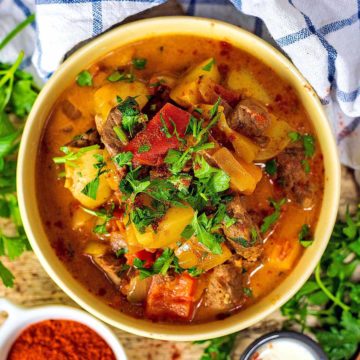
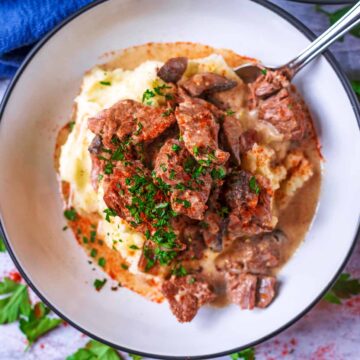
If you've tried this slow cooker brisket recipe, then let us know how you got on in the comments below.
Tag us in your creations on Instagram @hungryhealthyhappy and use the hashtag #hungryhealthyhappy too.
Recipe

Slow Cooker Beef Brisket



Recipe Video
Ingredients
- 2 kg (4 ½ lb) of Beef brisket joint
- ½ teaspoon of Fine sea salt
- 1 teaspoon of Ground black pepper
- 2 tablespoons of Olive oil
- 1 Onion - sliced
- 3 Garlic cloves - crushed
- 120 ml (½ cup) of Beef stock
- 3 tablespoons of Worcestershire sauce
- 5 sprigs of Fresh thyme
For the gravy:
- 250 ml (1 cup) of Brisket cooking liquid
- 1 tablespoon of Cornflour (corn starch)
- 3 tablespoons of Cold water
Instructions
- Season the brisket: Pat 2 kg of Beef brisket joint dry, then season it well all over with ½ teaspoon of Fine sea salt and 1 teaspoon of Ground black pepper. A dry surface browns much more effectively than a wet one.
- Brown it: Heat 2 tablespoons of Olive oil in a large frying pan and sear the brisket on every side until it has a good brown crust. This only takes a few extra minutes but adds a lot of flavour.
- Add everything to the slow cooker: Put 1 Onion (sliced), 3 Garlic cloves (crushed), 120 ml of Beef stock, 3 tablespoons of Worcestershire sauce and 5 sprigs of Fresh thyme into the slow-cooker bowl.Sit the browned brisket on top, with the fat side facing upwards if it has an obvious fat cap.
- Slow cook: Cover and cook for approximately 8 hours on LOW or 6 hours on HIGH for the 2kg joint used here.LOW is my preference when there is time. Brisket benefits from the gentler, longer cooking, and it makes the timing of a Sunday lunch wonderfully relaxed.
- Check for tenderness: Don't rely on the clock alone. Push a fork or temperature probe into the thickest part of the meat. When the brisket is properly tender, it should slide in with very little resistance. If it is still firm or chewy, it usually needs more time, not less.
- Rest before slicing: Lift the brisket onto a board and loosely cover it. Rest for around 10-15 minutes while you finish the gravy. Remove the string, then slice the brisket against the grain for the most tender slices.
To make the gravy:
- Remove the fat: Skim off as much fat as possible from the surface of the cooking liquid.
- Transfer 250 ml of Brisket cooking liquid to a saucepan. You should have around 250-300ml (1-1¼ cups).If you want a smooth gravy, you can strain out the onion, or blend some of it into the gravy for extra thickness and flavour.
- Make the slurry: Put 1 tablespoon of Cornflour (corn starch) into a small bowl and mix with up to 3 tablespoons of Cold water to make a smooth slurry.
- Whisk in the slurry: Bring the cooking liquid to a gentle simmer. Gradually whisk in the cornflour mixture, adding only as much as you need to thicken the gravy.
- Simmer the gravy: Simmer until the gravy reaches your preferred consistency, then season if needed and pour into a gravy jug.
Recipe Notes
- Cook on LOW when you can. HIGH works, but low and slow is exactly what this cut of beef loves.
- Don't assume a smaller joint needs the same cooking time. Start checking it earlier. Overcooked brisket can become dry.
- Sear for flavour, not safety. You can skip it when you're really pushed for time, but the browned crust makes the finished dish taste better.
- Don't drown the brisket. It doesn't need to be covered in stock. Your slow cooker traps moisture and the beef will release juices as it cooks.
- Keep the lid closed. Every time you lift it you lose heat and extend the cooking time.
- Rest before slicing. Ten to fifteen minutes gives you time to make the gravy and makes the joint easier to carve.
- Slice against the grain. This makes a noticeable difference to tenderness.
- Use tenderness as your main doneness test. A tough brisket usually needs longer.
- Keep the cooking liquid. It's one of the best things about this recipe.
Nutritional Information
Where nutritional information is provided, it is approximate and calculated using online tools. Values can vary depending on the ingredients and brands used, but we endeavour to be as accurate as possible.
All timings are a guide and may vary depending on the ingredients, equipment and, where relevant, the appliance used. Changing the serving size may also affect the time needed.

Sam says
What size slow cooker do you recommend please? Thank you
Narelle says
Followed the recipe and beef was tender and tasty. Served as sliders with coleslaw and had lots of positive comments. Nice easy recipe with simple ingredients already in the pantry.
Alouette Mills says
How long would you recommend cooking a 500g brisket joint for on low? Calculations would say 2 hours but I'm not sure that would be long enough? Thanks :)
Dannii Martin says
I would cook it on high for 3 hours and low for 5.
Linda says
How long should I cook for half the amount?
Dannii Martin says
For 1kg of brisket, I would recommend 5 hours on high and 7-8 hours on low. This is such a forgiving recipe though, and you really can't over cook it.
JONI says
I just made this as a half recipe - 1kg brisket and halved the rest of the ingredients. I cooked on low for 8 hours. It hasn’t worked my brisket is really dry :(
Dannii Martin says
It would by dry, because you used half the amount of brisket, but cooked it for the same amount of time. If you used a smaller joint, then it would cook quicker, so a smaller joint would over cook and become dry in 8 hours. This recipe is for the exact ingredients listed.
Fred says
You really need to amend this recipe re where to buy your brisket. All butchers will sell this and should be first port of call. Some supermarkets might sell it but it won’t be as good.
Gordon Mellstrom says
Made this earlier in the week and it is just great. Not too crumbly and not too tough, just right. Went down a treat with family as served with roast potatoes, Yorkshire puddings and a selection of mixed vegetables. Still using the leftovers in different sandwiches. Thanks for the best brisket recipe.
Dannii Martin says
So glad you enjoyed it. We love leftovers in a sandwich.
Mollie says
I've just written this out for the 'keepers' recipe book. Great recipe, looking forward to today's leftovers!
Samantha says
Cooked to perfection. Tasted amazing. Will 100% use this recipe again. Fantastic!
Kelly says
Hi there. If the woster sauce can't be used for health reasons, would you add more stock to ensure the liquid levels are the same? Thank you :)
Dannii Martin says
You can just leave it out - it won't change the liquid levels to a noticeable level.
james says
Family loved it. First time i didn't dry a brisket out.
Dannii says
It's so juicy isn't it. So glad you enjoyed it.
Jacqueline Debono says
I just got a new slowcooker and been looking for recipes to use it for during the holidays when we will be having family over. This brisket looks perfect! On my to make list!
Ian says
Do you need to let this rest like most meat? I like my meat hot
Thanks
Dannii says
You should always leave meat to rest for 5 minutes before serving, but if you like your meat hot then probably not.
Ian says
How long should you leave it to stand and would you put it back into the juices
Thanks
Amanda Wren-Grimwood says
I love slow cooked beef brisket and this recipe is so easy to make with no fuss but plenty of taste.